

A First Show Garden. An RHS Gold Medal. An Extraordinary Triumph.
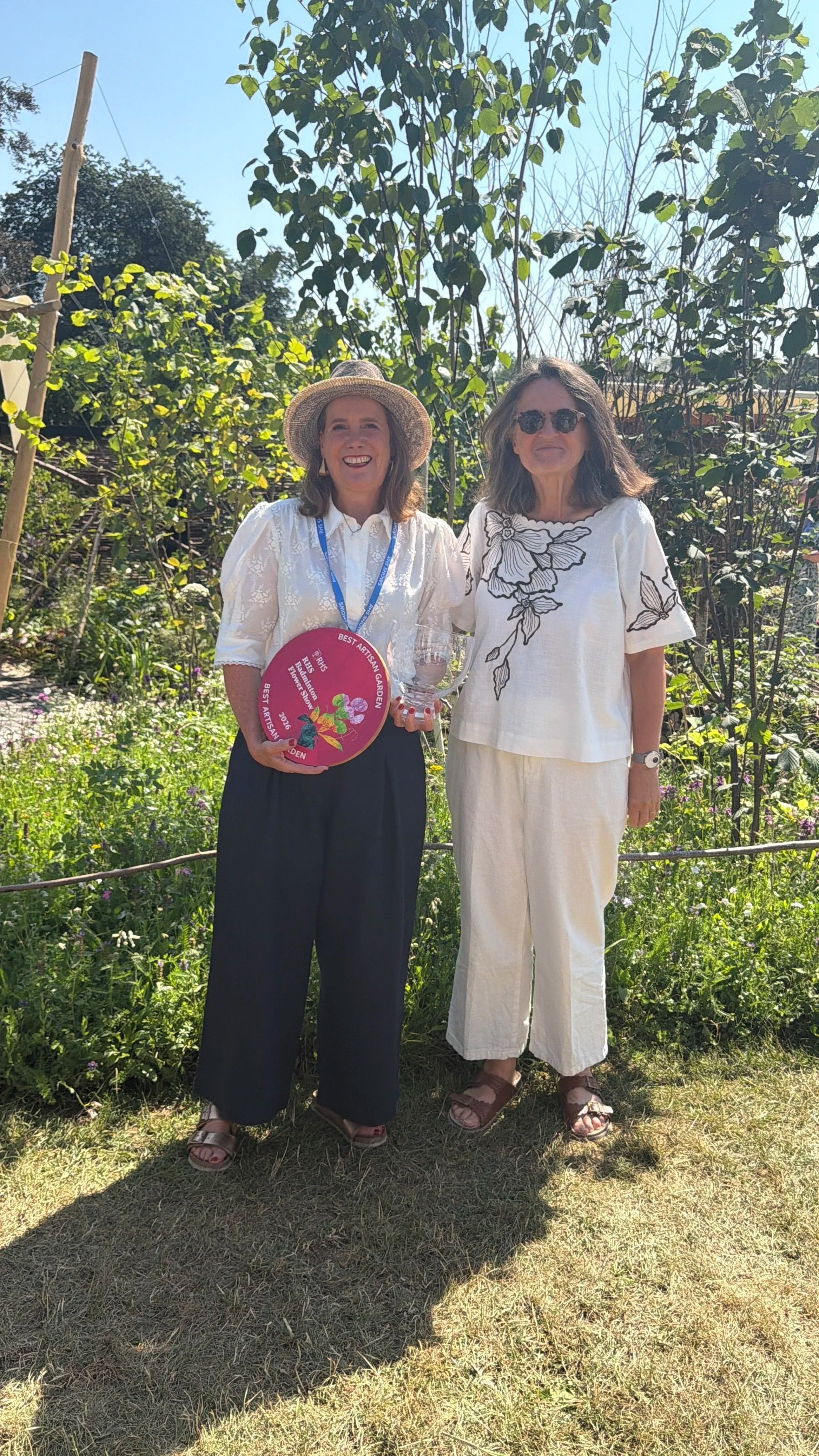
(above) Rachael pictured with Clare Matterson CBE, RHS Director General
There are achievements that feel significant, and then there are moments that exceed every expectation.
We are immensely proud to share that Rachael Austin’s first ever RHS show garden, the Ruskin Mill Trust Artisan Woodland Craft Garden, was awarded an RHS Gold Medal, named Best Artisan Garden, and received a Highly Commended award for Environmental Innovation at the inaugural RHS Badminton Flower Show.
For a first-time show garden designer to receive one of these accolades would have been remarkable. To receive all three represents an extraordinary triumph.
Rachael arrived at RHS Badminton having never designed a show garden before. She left with a Gold Medal, the highest award in her category and recognition for the garden’s environmental thinking. It is a rare and exceptional achievement, reflecting not only the strength of her design but the years of knowledge, sensitivity and practical experience behind it.
The garden brought together everything that defines Rachael’s approach to landscape: a deep understanding of place, a respect for natural materials, an instinctive eye for planting and a belief that gardens can carry social, educational and environmental purpose.
A Garden Rooted in Place and Purpose
Commissioned by Ruskin Mill Trust, the garden was designed to demonstrate how landscape, nature and traditional craft can support young people with special educational needs and disabilities.
Rachael drew inspiration from the distinctive valleys surrounding Ruskin Mill College in Nailsworth, Gloucestershire. Her design interpreted the woodland edge as a rich and layered environment, bringing together coppiced hazel, open glades, productive planting and traditional craft.
The result felt entirely at home within the landscape that inspired it. It was naturalistic without being uncontrolled, highly detailed without appearing over designed, and beautiful while remaining grounded in a clear educational purpose.
At the heart of the garden was Ruskin Mill Trust’s pioneering Practical Skills Therapeutic Education approach. Through working with plants, timber and other natural materials, students connect practical activity with personal development, building confidence and skills through the relationship between hand, head, heart and place.
Students from Ruskin Mill College were integral to the project. They helped cultivate plants grown at the college farm and demonstrated traditional green woodworking skills during the show, allowing visitors to experience the garden not simply as a finished composition, but as part of an active process of learning, making and participation.
It was this combination of landscape design, craft, education and human connection that made the garden so distinctive.
Environmental Thinking from the Very Beginning
Alongside the Gold Medal and Best Artisan Garden title, the garden received a Highly Commended award for Environmental Innovation.
This recognition is particularly meaningful to us as a certified B Corp.
At Austin Design Works, environmental and social responsibility are not additions made at the end of a project. They shape the questions we ask at the beginning: where materials come from, how they have been produced, who will benefit from a space and what will happen to it in the future.
The Ruskin Mill Trust garden embodied those principles throughout.
Materials were sourced locally wherever possible, borrowed, donated, grown specifically for the project or selected because they could be reused. Coppiced hazel celebrated a renewable woodland resource and the traditional skills associated with managing and working it. Plants were chosen not only for their role at the show, but for their ability to thrive in the garden’s permanent home.
The garden was never designed as a temporary spectacle to be admired for five days and then discarded. Its life beyond RHS Badminton was part of the design from the outset.
For a B Corp practice, this matters enormously. Responsible design is not simply about reducing the impact of construction. It means considering the entire life of a project and balancing environmental decisions with social value.
The garden did exactly that. It celebrated biodiversity, woodland management, low-impact materials and circular thinking while also creating opportunities for young people to learn, participate and connect with the natural world.
The environmental commendation therefore recognises something fundamental to the project: sustainability was not a decorative theme. It was embedded in every stage of the garden’s creation.
The Work That Happens After the Medals
Visitors see a show garden at its most complete: beautifully planted, carefully judged and filled with people.
What is less often acknowledged is what happens when the show closes.
Over the past few days, the team has been carefully dismantling the garden. The medals may have been awarded and the crowds may have gone home, but the work has continued.
Pull-down is not simply the reverse of the build. It requires the same degree of planning, expertise and physical care. Every plant must be lifted and protected. Root systems need to be preserved, structures dismantled safely and materials sorted according to where they will go next.
In the summer heat, this work has been particularly demanding. Plants have needed constant watering, careful handling and protection during transport to ensure they arrive safely at their forever home.
This unseen stage is an essential part of the garden’s environmental story.
A genuinely sustainable show garden cannot end when the gates close. The care taken during dismantling determines whether plants survive, whether materials can be reused and whether the resources invested in the garden continue to deliver value.
The Ruskin Mill Trust garden is now beginning its next journey. It will be relocated to Grace Garden School in Westbury-on-Trym, Bristol, where it will become a permanent place to support therapeutic outdoor learning for children and young people.
Rather than being broken up or sent to waste, its plants, timber and crafted elements will continue together as a living educational garden.
That legacy makes the environmental recognition even more powerful. The garden’s purpose was never limited to RHS Badminton. Its impact was designed to continue long after the show.
A First-Time Designer Supported by an Extraordinary Team
Although Rachael’s achievement as a first-time show garden designer is exceptional, no show garden is created alone.
This triumph belongs to a remarkable community of people who believed in the project and brought enormous skill, generosity and determination to its creation.
Thank you to the RHS for choosing and supporting the garden, and for staging such an ambitious and memorable inaugural RHS Badminton Flower Show at Badminton Estate.
Thank you to Ruskin Mill Trust for commissioning, sponsoring and believing in Rachael’s vision, and for making it possible for the garden to continue its life at Grace Garden School.
A huge thank you goes to Daniel Hoyle and the team at Greener Landscapes. They approached every challenge with patience, skill and good humour, including rotavating the hard ground eight times during a heatwave. To build a Gold Medal-winning garden at a first RHS show is an extraordinary accomplishment and testament to the quality of their work.
Thank you to everyone at Austin Design Works, particularly Rachael’s brother Matt for his unwavering support throughout the project, and to Carole for everything she managed behind the scenes.
We are deeply grateful to the growers, craftspeople, suppliers and businesses who donated, loaned, cultivated and transported the materials that made the garden possible: Wovenwood, Elm Tree Building Services, BTA Structural Design, Old Sodbury Trees and Plants, Allgreen, Natural Grower, Voltaire’s Wood, Nature First Trees, VRD Stroud, Blue Diamond Home & Garden Nailsworth, EverEdge, Graduate Gardeners and Hobbs House Bakery.
Special thanks must also go to Chris the Bodger, who demonstrated pole-lathe turning throughout the heatwave and shared his love of traditional craft so generously with visitors.
Our sincere gratitude also goes to garden maker and mentor John Hill, who loaned so many special plants from his nursery in Sherborne, and to every volunteer who helped transform the site into an RHS Gold Medal-winning garden in just two weeks.
Thank you, too, to the thousands of visitors who stopped, looked closely, asked thoughtful questions and shared such generous words of appreciation.
More Than a Beginner’s Success
It would be easy to describe this as an extraordinary debut, but that risks making it sound like beginner’s luck.
It was anything but.
The garden may have been Rachael’s first at an RHS show, but it was the result of 25 years spent designing landscapes, understanding plants, working collaboratively and creating places that respond sensitively to people and their surroundings.
Rachael brought that experience to RHS Badminton and delivered a garden that impressed the judges, connected deeply with visitors and remained completely true to its original purpose.
An RHS Gold Medal, Best Artisan Garden, and Highly Commended for Environmental Innovation.
All achieved with her first show garden.
It is an enormous professional and personal triumph, and one of which everyone at Austin Design Works is profoundly proud.
The garden’s time at Badminton may be over, but its story is not. Its plants are being protected, its materials preserved and its purpose carried forward into a permanent new home.
For Rachael, this unforgettable first show garden marks not an ending, but the beginning of an exciting new chapter, and of course, she is available for commission!